And the Golden Chile goes to…

GOLDEN CHILE FRAMECrank up the heat, and that’s when you can tell the men/women from the boys/girls.

And that’s exactly what happened at the first annual Tri-Ed San Antonio Chili Cook Off. Because the competition was hot for first-time chili cooker-offer (cooker-offer – a new phrase but a good one), Phillip Baker and his team.
CHILI COOKOFF 1CHILI COOKOFF 2

Luckily Phillip had the Los Chileros double-whammy of Chile Molido (hot) and Chimayo powder in his pot. The result? Phillip’s team beat the competition to grab the coveted crown. Phillip tips his hat to Los C and says, “I think the real secret, in addition to the powder, was the fact that I ground up all the meat the night before. Fresh ground just tastes better I think.”

Phillip you got that right.

So Phillip and his team can now add another feather to their chili cap – the Golden Chile. No prize money but lots of bragging rights. Congrats Phillip and best of luck next year.

You’ve got someone you think deserves the Golden Chile? Someone who has gone the extra culinary mile to make the chile star shine a bit brighter? Let us know because maybe—just maybe—they’ll be our next Golden Chile winner.

Chile Mango Salsa

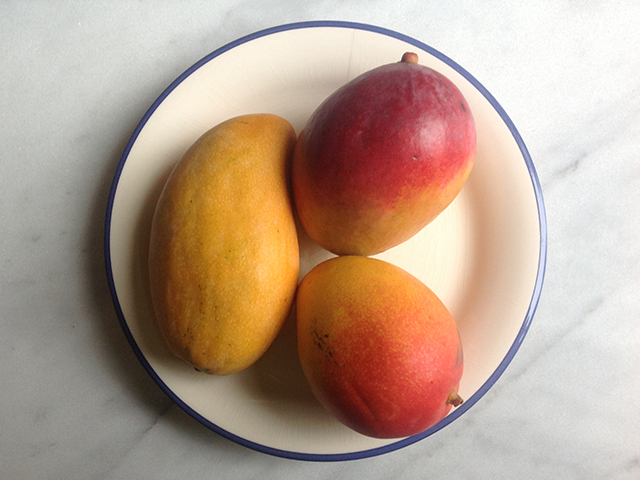
Mangos are sexy. There, I’ve said it. Sure, it’s a tropical fruit and we know tropical is sexy but it’s more than that. They’re lush and perfumed…juicy and succulent. Hold a ripe mango up to your nose and take a deep whiff and you’ll know what I’m talking about: it’s heaven. And the best thing – that lovely sweetness isn’t afraid to stand up to chile. In fact, the two were made for each other.

MANGO 1

Once upon a time, it was tough to get mangos but now it’s pretty easy. Most of our mangos come from Mexico, Haiti, the Caribbean and South America but you’ll find them growing in tropical climates all over the world. The countries where we get our mangos from have two main growing seasons so you can usually find mangos year round. And you’ll find some homegrown mangos from Florida, Hawaii, California and Puerto Rico.

For something that tastes so decadently sweet, mangos are surprisingly good for you. Actually, astonishingly good for you.They’ve got loads of Vitamins A and C and buckets of potassium. And very high fiber too, if I might add. And best of all they’re low calorie – about 110 calories for an average mango. Not bad.

MANGO 3

I think what puts some people off mangos is slicing them and I’ll be honest, it is a bit of a fiddle. There is a fairly large stone in the middle which the flesh clings too so you can’t simply slice it in half like an avocado. You’ve got to slice around the stone and then take the skin off. It’s no big deal and I share my tips to make it easy in the recipe. Or go online and check out a video tutorial.

Lastly, before you slice into a mango, make sure it’s ripe. You can’t always tell by the color. Different varieties can be dark green, vibrant yellow or yellow and green with a red blush that makes it look like a really delicious Tequila Sunrise. The best test, is to gently press the skin. It should yield slightly. Oh, and of course take a whiff. Now tell me that’s not sexy.

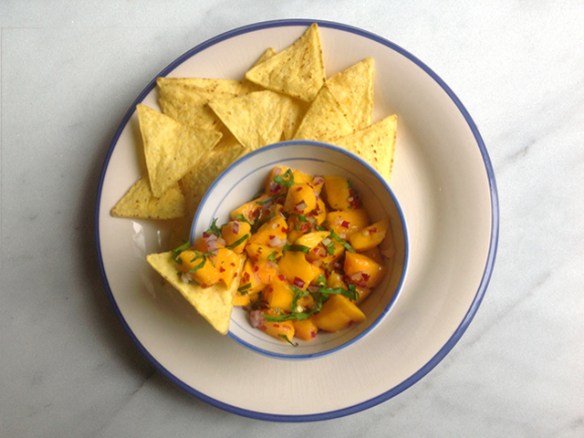
MANGO 4Chile Mango Salsa

Makes about 1 cup of salsa but feel free to double or triple the recipe

1 ripe mango, cubed (see below) – about 1 cup
1 Tbsp red onion, finely chopped
Juice of ½ lime
1 Tbsp cilantro, finely chopped
½ tsp chile pequin
Pinch of sea salt
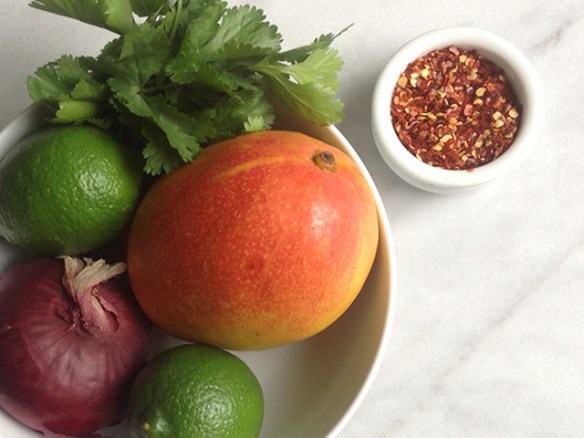
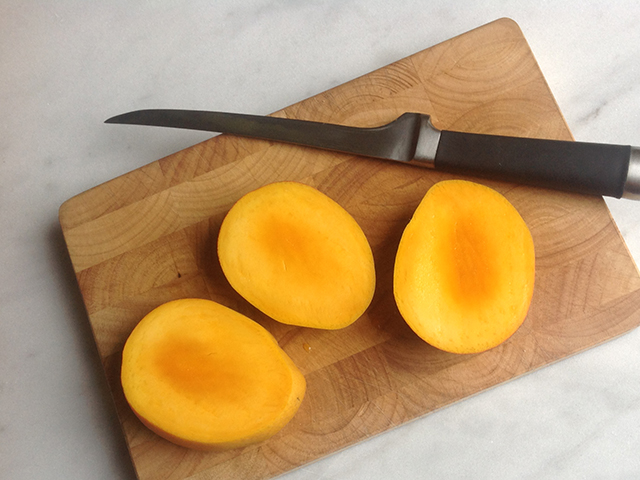
MANGO 2Mangos have a stone in the center that is about an inch wide. Insert the tip of your knife into either side of the stone. If you hit the stone, don’t worry. Just lift your knife and move it slightly over. Once on one side of the stone, slice through. Repeat on the other side. You now have two ‘cheeks’  that are slightly boat shaped. To remove the skin, place a cheek on your chopping board and slice it in half lengthwise. You’ll now have two quarters. Repeat with the other cheek so you have four quarters in total.

Now take your knife and insert it at one end as close to the mango skin as possible. Slide the knife between the skin and fruit to separate the two. I use a filleting knife for this because it has a slightly flexible blade that I find easier to use with mango. Repeat with the other mango quarters. You can also get an additional piece of flesh off either side of the stone. Dice the flesh.

MANGO 5

Mix the mango with the other ingredients, check for seasoning and serve. Superb with chicken, seafood – shrimp, scallops, tuna, swordfish (you get the idea) or simply a bowl of tortilla chips. Best made no more than an hour or so before serving.
Chile Sea Salt Chocolates

You’re stranded on a desert island. You can take ten foods with you. And no, there isn’t any other food on the island. Just you, a lot of sand and some palm trees.

CHOC 1So what’s it going to be? Love asparagus? How about eating it everyday for the rest of your life? I mean, think about it – ten foods to eat forever. It’s not easy. Now the practical me, says lemons. They taste great and I won’t get scurvy and end up looking like a toothless pirate.

CHOC 8

Chile, of course. Silly question. I’d have my own cache of red and green in powder, crushed and whole. Another no-brainer is chocolate. If I’m hanging out on an island, I want some chocolate because it a) tastes so darn good and, b) makes life look a bit better.

No wonder I love all those articles about the health benefits of chocolate – particularly dark chocolate. There are studies that say it decreases stroke risk, lowers blood pressure, reduces bad cholesterol, boosts your mood (no surprise there), improves vision and even has flavinoids that protect your skin from UV damage. Maybe I could slather some chocolate on as a sunscreen on my island…

And chocolate is a natural with chile. The ancient Aztecs loved drinking chocolate with chile. There’s a great book called The True History of Chocolate by Sophie and Michael Coe that charts the history of chocolate including the chocolate/chile connection.

But I digress….I’m off to a deserted island and I’m taking chocolate, chile and lemons and…I’ll get back to you…

What are your top-ten desert island food picks? Share them with us.

CHOC 7Chile Sea Salt Chocolates

This is my desert island homage. It’s got chile and chocolate and a pinch of sea salt. Heaven.

Makes approximately 20 1 ¾” dark chocolate discs and 20 white chocolate discs.

Dark Chocolate Discs

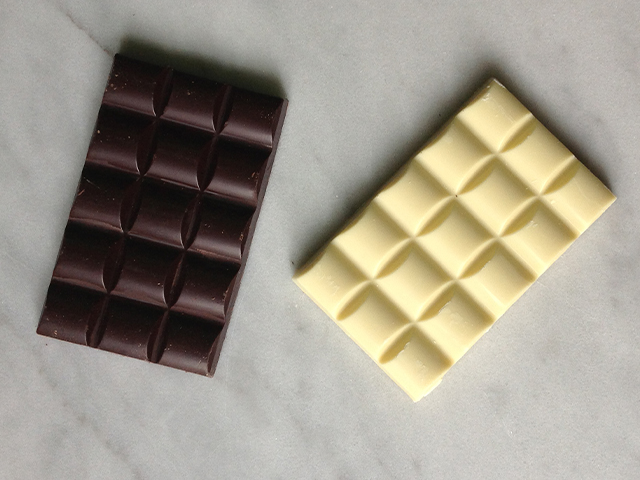
5 ½ oz dark chocolate (minimum 70% cocoa solids)
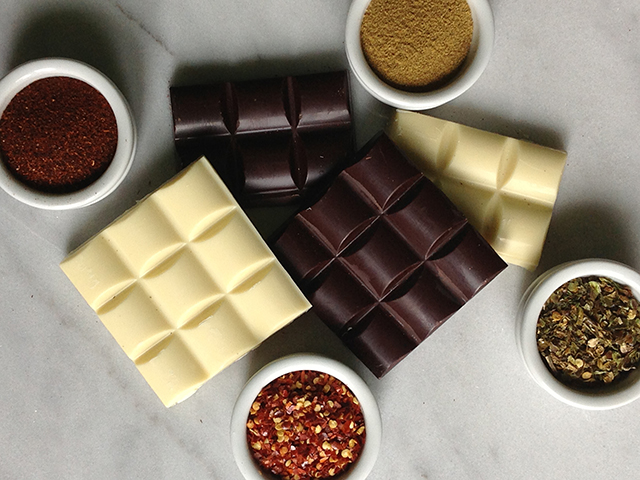
1 tsp chile molido (or more to taste)
1 tsp
chile pequin
1 tsp sea salt flakes
1 Tbsp pistachios, roughly chopped

White Chocolate Discs

5 ½ oz white chocolate
1 tsp green chile powder (or more to taste)
1 tsp green chile caribe
1 tsp sea salt flakes
1 Tbsp pine nuts, lightly toasted

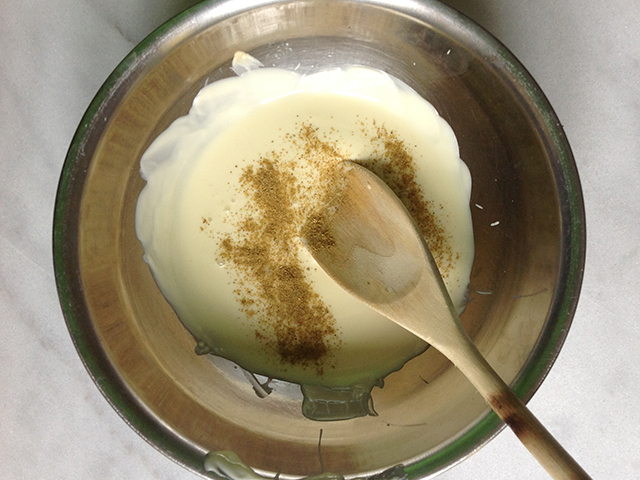
CHOC 3CHOC 2The technique for both white and dark chocolate is the same. Place the chocolate in a heat-proof bowl and set the bowl over a saucepan filled with simmering water. Melt the chocolate making sure not to over heat it– chocolate can easily separate. When about two-thirds of the chocolate is melted, remove the bowl from the saucepan and stir until the chocolate is completely melted and silky smooth. Stir in the chile powder and taste. You can add more if you’d like more heat but remember you’re topping with chile flakes so don’t go overboard.

CHOC 4

CHOC 5

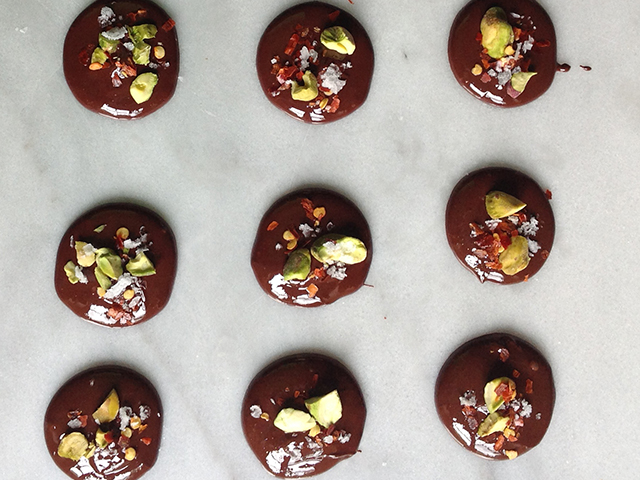
CHOC 6Place a non-stick silpat sheet or piece of baking parchment on the counter. Spoon about a tablespoon of the melted chocolate onto silpat or parchment to form a round disc, about 1 ½ to 1 ¾“ in diameter. Dot each one with a few nuts, chile pepper flakes and sea salt flakes. Repeat with the rest of the chocolate. Set aside until the chocolate hardens.

Can be kept in a container in a cool place (but don’t refrigerate).

Aglio e Olio

You’re tired. It’s been a long day. You hate your job and your life. And you’re very, very hungry. You get home and open up the fridge door. And the refrigerator laughs. It laughs as if to say, “What did you expect? Something to eat?” Because the fridge is empty. Sure there’s a jar of olives – or are they pickles? And something that used to be lettuce back in the ‘50’s. But there’s nothing you can eat without risk of food poisoning.

FRIDGE

So you can 1) give up and go to bed, 2) go out and go shopping (are you kidding?) or, 3) get creative. Let’s go for option 3. Scrounge around – and I mean properly scrounge around – and you’ll probably find something. We’re talking about what cookbooks call ‘store cupboard staples’. These are the dry goods you should – and I emphasize should – have on hand. Okay, you’re no Martha Stewart but you do keep something in those cabinets, don’t you?

OAP1

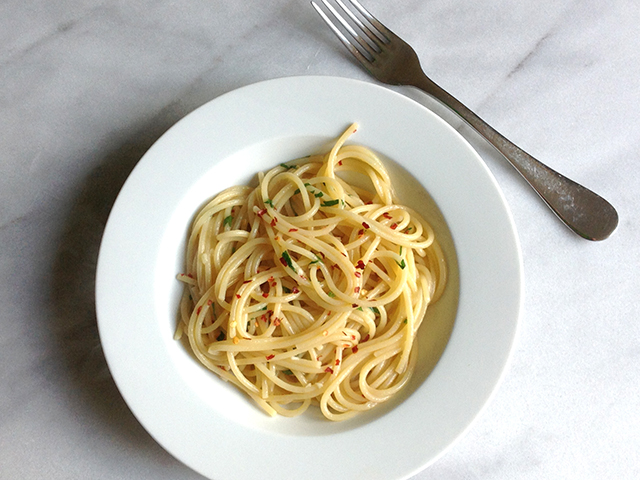
Here’s a crisis (because that’s what this is) meal that you can probably whip up. All you need is pasta (spaghetti please), red chile flakes, garlic, and olive oil. And running water. And electricity or gas. You get the idea. The dish is Aglio e Olio – or Aio e Oio  if you’re in Rome. It’s a classic example that the less you fuss about with food the better it tastes.

OAP 3

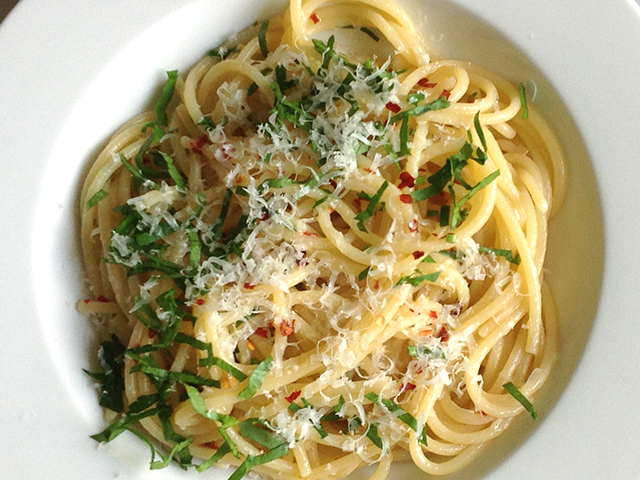
A couple of suggestions…sauté the garlic in a large sauté pan. Don’t drain the pasta but instead scoop it out and place in the pan with the garlic/olive oil/chile mixture. The small amount of water that clings to the pasta will make the dish taste better and richer. Add fresh parsley – if you’ve got it– and parmesan if you want (not traditional but tasty nonetheless). While you’re eating it, make out a grocery list. No more laughing refrigerators, promise?

Aglio e Olio

2 servings or 1 if you’re famished

Salt
½ pound spaghetti
3 Tbsp olive oil
2 garlic cloves, finely minced
½ tsp or more chile pepper flakes
¼ cup parsley, finely chopped
grated parmesan (optional)

Bring a large pot of water to boil. Add 1 Tbsp salt and the pasta. Cook according to the package directions until al dente (with a bit of bite and definitely not mushy).

Meanwhile, heat the olive oil and gently sauté the garlic and the chile flakes in a large skillet. This will only take a minute or two. You do not want to brown the garlic or burn it. When the pasta is done, scoop it out of the water and place in the pan with the garlic, olive oil and chile flakes. Reduce the heat. Toss to coat the pasta until any excess water is absorbed (only a minute or two). Taste and add salt or more chile flakes, if desired. Stir in the parsley. Place in bowls and garnish with parmesan – if using.

OAP2

Chile Portrait: Guajillo

You could splash out on a gym membership. Or you could buy a mortar and pestle and bash the living daylights out of a couple of Guajillo chiles for our Mojo Rojo. The difference? The mortar and pestle is a lot cheaper and you end up with a tasty condiment that you can slather on everything (almost). But the biceps, well they’ll be pretty much the same.

GUAJILLO 1

Guajillos (pronounced gwah-HEE-yoh) have tough skins. If you’re soaking them (which I recommend) do it for a bit longer than you would say, a New Mexico red. They’re about 4-6 inches long and reddish-brown in color. They’re super popular in Mexico – one of the most commonly grown – and used for soups, stews, adobos, salsas – you name it. But back home, they’re not as well known which is a shame, since the Guajillo is a real culinary workhorse.

A Guajillo has some heat but not tongue-numbingly so. On the Scoville index it sits below the jalapeno. Take out the seeds to reduce the heat or – as I’ve done with the Mojo Rojo – leave them in. Because the skin it tough, it’s hard to end up with a smooth paste but that’s not a bad thing. The Guajillo packs a lot of flavor – beyond mere heat –that you can pick up when your salsa or sauce or rub is chunkier. Mark Miller in his book, The Great Chile Book, describes a Guajillo as having a, “…green tea and stemmy flavor with berry tones.” Sounds good to me.

As always with dried, whole chiles look for ones that are still pliable. You may think that a dried chile should be stiff but that’s not true at all. It should give a bit when you bend it and never smell musty. Give it a sniff and enjoy those lovely warm, fruity aromas.

GUAJILLO 3

And a word of advice. If you are using a mortar and pestle, try to alternate between your left and right hands. Otherwise you could end up with the Popeye bicep look. Just a thought…

Mojo Rojo

Makes about ½- ¾ cup (recipe can be doubled)

Yes, you can make this in the small bowl of a food processor or a blender (wimp). But then you’ll miss out on the pure physical pleasure of pounding a Guajillo chile into oblivion. Your choice.

2 Guajillo chiles
6 cloves of garlic, peeled and sliced in half
1 tsp sea salt
1 tsp cumin seeds
1 ½ tsp sweet pimenton (Spanish smoked paprika)
½ cup extra virgin olive oil
2 tsp red wine or sherry vinegar

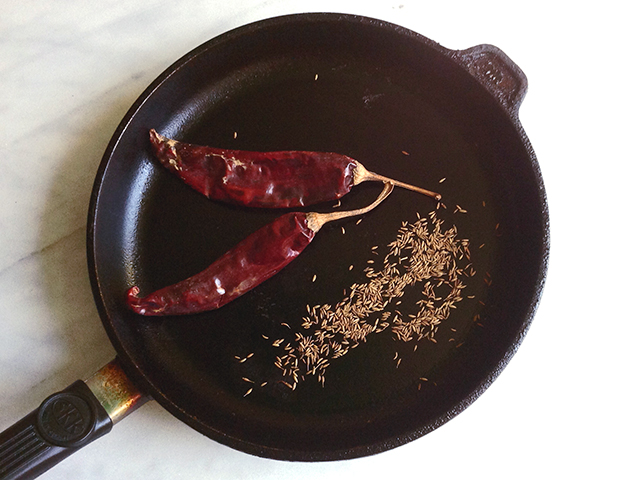
Heat a frying pan on medium-high heat. Add the whole chiles and toast gently on all sides. The idea is to bring out the flavor of the chiles but do not scorch or burn them. If you do, start over. You can toss the cumin seeds in to – it will bring out the flavor beautifully. Place the toasted chiles in a bowl and cover with hot but not boiling water. Let soak in the water for about 15-20 minutes until pliable.

GUAJILLO 2

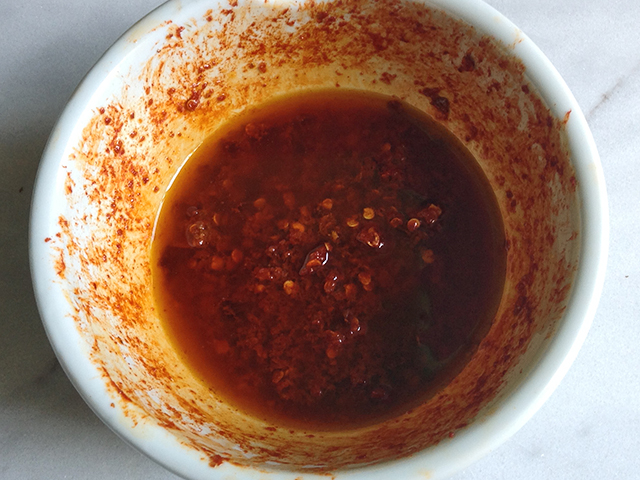
Meanwhile, place the garlic, sea salt and toasted cumin seeds in the base of a mortar (or use a food processor or blender). Beat with the pestle until a rough paste is formed. Drain the chiles, remove the stem and roughly chop. Add to the mortar and pound until the chile is broken down into small bits. You are not going for a smooth paste – you’ll end up with seeds and chile pieces. Mix in the sweet pimenton, olive oil and vinegar. Season with salt if needed.

GUAJILLO 4

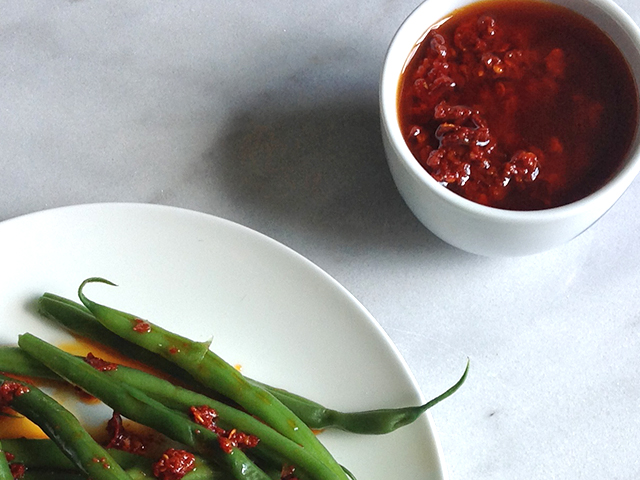
Mojo Rojo is great with:
• Green beans or other blanched green vegetables
• Boiled new potatoes
• Butternut squash or sweet potatoes
• Steak, chicken or pork tenderloin
• Spread on bread or as a thick dip for raw veg

GUAJILLO 5